
Trapped in the Bloom.
WTF is that dude talking about? I just don't get it...

What follows is a brief table and some supporting information on how humans think. The reason this matters is that all of Officialdom are academically trained and thus their minds are limited to the frameworks and constraints put in place within that training. As an instance, Bloom’s Taxonomy (detailed near the end of this article) is the foundational framework for how Officialdom thinks about thinking, and it is crushingly flawed. It fails to note key levels of human thinking that exceed the limits that Bloom set.
This is vitally important in that without this context many key decisions will be made in error, in absence of important considerations that include how we are thinking about the problems and how we are thinking about our thinking about the problems.
In no area is this more strategically valuable than the UFO subject. As an instance, what level of thinking is required to create UFO/UAP phenomena? And as a coralary, would it not be logical to have the widest possible view of the issues facing us? Which would naturally include how the UFO phenomena affects our thinking about the UFO phenomena.
i begin this with a table detailing my additions to Blooms Taxonomy.
A significant difference is that Bloom ended his context on thinking with meta-cognition as an active tool, used on occasion to ‘tune’ your thinking about how to learn. He did not conceive of meta-cognition as an active, on-going, self analytical, in real time self monitoring, developing perpetual state of process. Thus in Bloom’s model, such humans as display psychic or ‘enlightenment’ abilities are completely excluded. In my model they are merely expressions of higher order thinking that is always, continuing, and continuously seeking to manifest at more advanced levels.
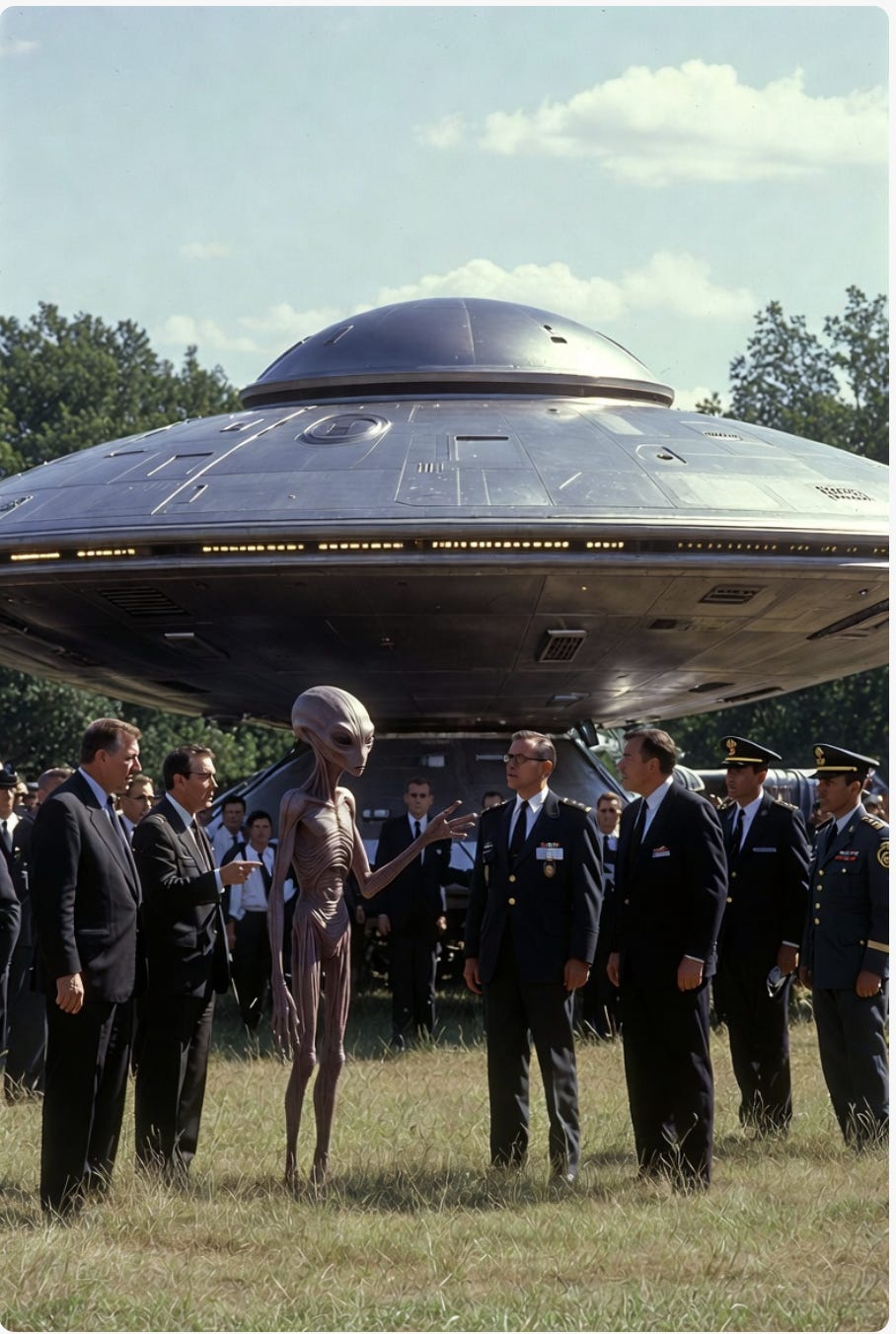
Now that the Bloom trapped normies are beginning to seriously consider the idea of ‘aliens’, it would be logical that humanity analyses our situation as to how best to meet and greet our cosmic neighbors and their manifestations such as #3IATLAS and the plethora of UFOs.
It would seem an error to assume that aliens have their own ‘officialdom’, and that such should it exist, would be limited to thinking about humans within their own Bloom trapped minds.
An aspect of the shift in paradigms that is this period (from rational materialism to consciousness substrate co-creation based) is that species would tend to develop a more realistic appraisal of itself, their capabilities, and the challenges that they face.
In conclusion, if the aliens are using Meta-cognition to create the UFO phenomena and to scope out humanity, then logically it would behoove the humans to be thinking about this at that same level….or a higher state.
We don’t have much experience finding such thinking in officialdom. As this paradigm shift expresses further, we can expect a re-engineering of how we organize our social order to arise naturally.
### Thinking Hierarchy vs. Bloom’s Taxonomy: A Deeper Comparison
This table compares a proposed hierarchy of consciousness/thinking stages (pre-meta → meta → post-meta/cosmic/eternal) with Bloom’s Revised Taxonomy (2001 cognitive domain). Key distinction: From **metacognition** onward, stages involve **active co-creation of reality** in alignment with supreme/universal consciousness, plus significant ability to **manipulate the event-stream** (influencing outcomes, synchronicities, manifestations, etc.).
| Stage | Type of Thinking | Key Features & Description | Bloom’s Equivalent Level | Key Comparison / Contrast |
|--------------------|-------------------------------|--------------------------------------------------------------------------------------------|-------------------------------------------|-------------------------------------------------------------------------------------------|
| Pre-Meta-Cognition | Instinctive/Reflexive | Automatic reflexes, survival instincts; no conscious deliberation | Remembering | Basic recall; passive, no reality shaping |
| Pre-Meta-Cognition | Perceptual | Sensory processing to form recognitions | Remembering / Understanding | Foundational input; reality passively received |
| Pre-Meta-Cognition | Concrete | Literal, tangible, present-focused; no abstraction | Remembering / Understanding / Applying | Practical application; no deeper influence |
| Pre-Meta-Cognition | Abstract | Ideas, concepts, hypotheticals beyond the immediate | Understanding / Applying | Conceptual reasoning; still within “given” reality |
| Pre-Meta-Cognition | Critical | Analyze, evaluate, synthesize with logic/evidence | Analyzing / Evaluating | Rational judgment; influence limited to decisions |
| Meta-Cognition | Meta-Cognition | Thinking about thinking; self-monitoring & regulation. **Co-creation begins**: awareness of thought shaping experience; alignment with supreme consciousness starts; initial event-stream influence (belief/intent shifts outcomes) | Metacognitive Knowledge (supportive, not peak) | Bloom sees it as learning aid; here it’s ontological gateway to participatory reality |
| Post-Meta-Cognition| Cosmic/Universal Cognition | Self as universe observing itself; expanded non-dual awareness. **Active co-creation** with supreme consciousness; **significant event-stream manipulation** (synchronicities, manifestation, probabilistic influence) | Beyond Creating (no equivalent) | Bloom peaks at human creativity; this transcends to unified co-creation & direct flow influence |
| Post-Meta-Cognition| Eternal Cognition | Pure, unlabeled observation; ultra-high cognition without reference/context. **Full co-creation**; effortless event-stream as natural expression of unified awareness (reality arises seamlessly, minimal ego) | None | Beyond all conceptual frameworks; non-dual witnessing where observer & observed co-arise |
#### Summary Insights
- **Pre-meta levels** align closely with Bloom’s lower-to-mid tiers: intellectual processing of a seemingly external, fixed reality.
- **Metacognition & beyond** mark a profound shift: consciousness becomes **participatory**—actively co-creating with supreme/universal awareness and manipulating experiential/event flow in ways education taxonomies don’t address.
- Bloom’s is pedagogical/secular (measurable learning outcomes). This model extends into transpersonal, metaphysical, non-dual realms (echoing Advaita, quantum consciousness ideas, mysticism).
Bloom’s Taxonomy is a foundational framework in education that classifies learning objectives into hierarchical levels of cognitive complexity. It helps teachers, instructional designers, and learners structure goals, activities, assessments, and questions from basic recall to advanced critical and creative thinking.
Original Bloom’s Taxonomy (1956)
Developed by Benjamin Bloom and a team of educators, the original version used nouns to describe six levels in a pyramid (from lowest to highest cognitive demand):
Knowledge — Recalling facts and basic concepts (e.g., define, list, name, recall, state).
Comprehension — Understanding meaning, interpreting, and explaining ideas (e.g., describe, explain, summarize, translate).
Application — Using information in new situations (e.g., apply, demonstrate, illustrate, use).
Analysis — Breaking down information into parts and understanding relationships (e.g., analyze, compare, differentiate, examine).
Synthesis — Combining elements to form something new (e.g., create, design, compose, invent).
Evaluation — Judging value based on criteria (e.g., assess, critique, justify, evaluate).
This version emphasized a progression where higher levels build on lower ones.
Revised Bloom’s Taxonomy (2001)
In 2001, Lorin Anderson (a former student of Bloom) and David Krathwohl led a revision, published in A Taxonomy for Learning, Teaching, and Assessing. The updated version made several key changes to better align with modern pedagogy:
Nouns → Verbs — Levels now use action-oriented verbs to reflect active cognitive processes (thinking is dynamic).
Top two levels swapped — “Synthesis” became “Creating” (now the highest), and “Evaluation” moved down one spot, as creating often requires prior evaluation.
Two dimensions added (though the core is still the cognitive process):
Cognitive Process Dimension — The six levels below.
Knowledge Dimension — Factual, Conceptual, Procedural, and Metacognitive knowledge (crossed with the processes for more nuance).
The revised six levels (from lowest to highest):
Remembering — Retrieving and recalling relevant knowledge from long-term memory. Verbs: define, duplicate, label, list, memorize, name, recall, recognize, repeat, state, tell.
Understanding — Constructing meaning through interpreting, summarizing, inferring, comparing, explaining. Verbs: classify, describe, discuss, explain, identify, interpret, locate, paraphrase, recognize, report, select, summarize, translate.
Applying — Carrying out or using a procedure in a given situation. Verbs: apply, choose, demonstrate, dramatize, employ, illustrate, implement, interpret, operate, schedule, sketch, solve, use, write.
Analyzing — Breaking material into parts, detecting relationships, and organizational principles. Verbs: analyze, appraise, categorize, compare, contrast, deduce, differentiate, discriminate, distinguish, examine, infer, organize, outline, question, relate, test.
Evaluating — Making judgments based on criteria and standards through checking and critiquing. Verbs: appraise, argue, assess, award, choose, compare, conclude, criticize, decide, defend, determine, evaluate, judge, justify, measure, prioritize, rate, recommend, select, support, value.
Creating — Putting elements together to form a coherent whole or reorganizing into a new pattern/structure (highest level). Verbs: adapt, build, change, combine, compile, compose, construct, create, design, develop, formulate, generate, hypothesize, invent, make, modify, originate, plan, predict, produce, propose, reorganize, revise, solve, suppose, test.
Key Differences: Original vs. Revised
Original: Noun-based, Evaluation at the top (judging value as peak).
Revised: Verb-based, Creating at the top (innovation/generation as ultimate cognitive goal), reflecting 21st-century emphasis on creativity and problem-solving.
The revision is now the most widely used in education, curriculum design, and assessment because it’s more actionable and measurable.
Why It Matters
Bloom’s (especially revised) is used to:
Write clear, progressive learning objectives (e.g., “Students will be able to analyze...” vs. just “know about...”).
Design questions, activities, and exams at varying depths.
Promote deeper learning beyond rote memorization.
It’s primarily for the cognitive domain (thinking/knowledge), but Bloom’s team also developed taxonomies for affective (attitudes/emotions) and psychomotor (physical skills) domains.
*******************
Conclusion. Frameworks are fantastic…as tools along the way. Universe provides and guides for increased complexity that is never considered as an aspect of any of the frameworks we devise as tools. This is true of Bloom’s work as well. It’s good, but limited, and limiting on our thought processes at a time when we need the opposite.
Housekeeping. Note that on Feb 25 i am still in the midst of many projects here including the repair of my server base (hardware failure -parts on the way) so my interaction is curtailed for a while until i get through the repairs and some time sensitive projects.
Clif is pointing at something most of Officialdom cannot even see, let alone think about.
Bloom-trained minds top out at “thinking about thinking,” but Clif is talking about thinking that shapes the event stream itself. That’s not philosophy class—that’s participation in reality.
If UFO/UAP phenomena are being generated or guided by intelligences operating at those higher cognitive levels, then trying to analyze them with bureaucratic, Bloom-box thinking is like bringing a ruler to measure lightning.
The real takeaway here is not just UFOs—it’s that our model of mind is too small. And when your model of mind is too small, every decision built on top of it is compromised from the start.
Clif’s hierarchy pushes the door open: from passive observers of a fixed world to co-creative participants in a living field. That shift alone explains why Officialdom keeps missing the signal.
The Wolf translation: expand your awareness or get outplayed by those who already have.
Lone Wolf
Good morning Woo Crew!